
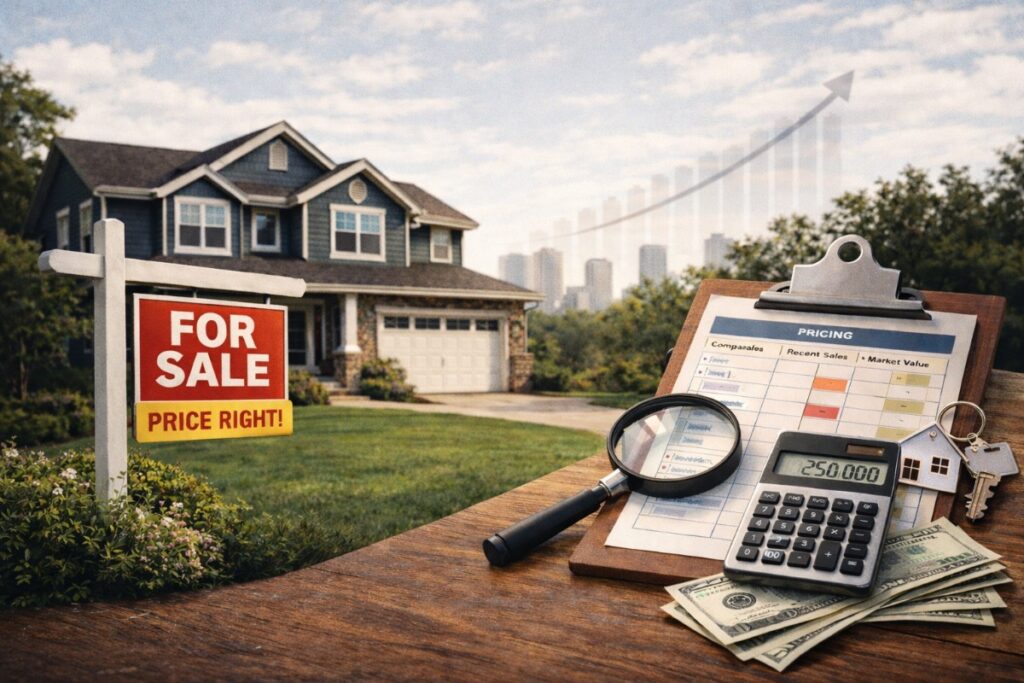
As a real estate agent, licensed in Kansas and Missouri since 2011, I’ve helped countless sellers determine the best strategy for pricing their homes. Pricing your home is different for everyone, but the priorities are generally the same: maximize proceeds, selling on time while minimizing risk and reducing stress. I’ve seen firsthand how the right pricing strategy can help sellers not just hit, but exceed their real estate goals.
In a market like this, pricing isn’t just about picking a number; it’s about developing a strategy that understands buyer psychology, market dynamics, and data-driven insights. In this post, I’ll share my expertise, drawing from real experiences, and proven philosophies to help you price your home correctly.
Whether you’re in Overland Park, or elsewhere in the Kansas City metro, these general principles apply. Let’s dive in!
- Why Pricing Your Home Correctly Matters More Than Ever
- My Step-by-Step Approach to Pricing: The Comparative Market Analysis (CMA)
- Key Pricing Strategies: From Brackets to Bidding Wars
- Case Studies: Real Lessons from the Field
- Expectations vs. Reality = Level of Satisfaction
- Common Pitfalls: The Dangers of Overpricing
- Navigating 2026 Market Dynamics in Overland Park and KC Metro
- Final Thoughts: Price You Home for Success, Not Ego
Why Pricing Your Home Correctly Matters More Than Ever
Pricing a home too high can be a costly mistake. In the Kansas City metro area, where the average days on market (DOM) hovers around 49 days (up slightly from last year), overpriced homes linger longer, which can start to make buyers wonder, “What’s wrong with it?” This leads to price reductions, which typically result in a final price that’s below what you could have achieved with proper pricing from the start.
Conversely, strategically pricing your house can create urgency and competition. With the median home price in Johnson County being $467,000 (up 5.2% from last year), the key is positioning your home to attract the strongest buyers who are wiling to pay more for your house.
My Step-by-Step Approach to Pricing: The Comparative Market Analysis (CMA)
Pricing your home starts with putting yourself in the buyer’s shoes. What other houses are available to choose from, and what would they pay for yours? To answer that, we conduct a thorough CMA using data from the Multiple Listing Service (MLS). Here’s how it’s done:
- Gather Comparable Properties (Comps): Look for similar homes: ideally the same size and floorplan, features, and condition, in your neighborhood. I’m looking at:
- Active Listings: This is your current competition (homes not sold yet).
- Sold Listings: What have buyers paid for similar houses in the last 30, 60, 90, 180, 365 days.
- Expired/Canceled Listings: What houses didn’t sell, and why?
- Refine the Data: Exclude comps that differ by more than 10-15% in size. It’s a good rule of thumb to never compare one-story homes to two-story homes, as their valuations will never truly be comparable. Also, avoid price per square foot as a primary metric; it’s often misused and doesn’t account for features like pools, garages, or condition. Make small adjustments to account for differences in condition, upgrades and features.
- Calculate Months of Supply: This is how you determine market velocity for your neighborhood:
- Months of Supply = Active Homes For Sale / (Homes Sold in Last 6 Months / 6 Months)
- Under 4 months = Seller’s Market
- 6 months = Balanced (no price pressure)
- Over 8 months = Buyer’s Market
- In Overland Park, we’re currently seeing about 1.3 months of supply. While this technically favors sellers, it’s a much more balanced than we’ve seen in recent years.
- Expand the Search: Once you have a range of value, double check that price point in a larger geographic area. This lets you see what else buyers are choosing from when they house shop.
This data-driven process gives a fair market value, but then we layer on strategy.
| Market Indicator | Overland Park (Jan 2026) | Johnson County, Kansas |
|---|---|---|
| Months of Supply | 1.3 months | 1.6 months |
| Median Sale Price | $495,000 | $465,000 |
| Average DOM | 45 days | 50 days |
Sources: Heartland MLS data as of Jan 2026.
Key Pricing Strategies: From Brackets to Bidding Wars
When it comes to determining market value, nobody cares what we think (NCWWT). The market decides the value. Your real estate agent’s job is to expose your home to the world’s best buyers, and ideally, negotiate the highest price someone would pay for your house. Here’s how:
- Price Brackets and Positioning: Buyers search for houses using round numbers ($25k, $50k, $100k). Each price bracket contains a certain number of buyers actively shopping for a home like yours. The lower the bracket, the exponentially higher the number of buyers looking in that range. Pricing your home to align with how buyers search allows you to reach the maximum number of qualified prospects. Conversely, listing in the wrong bracket can make your home invisible to a growing pool of potential buyers.
- Strategic Pricing for Bidding Wars: In markets like ours, strategic pricing hooks buyers emotionally. You want to deal with well-qualified buyers who fall in love with your house. Your house is their favorite. With proper marketing, we find the best buyers who will fall in love and be willing to pay more.
- Timing and Adjustments: Your asking price doesn’t dictate the selling price…it dictates how long you’ll wait to get what the market gives you. Asking for a more aspirational price can leave you sitting on the market longer than you should be, which is something buyers will notice. If the market doesn’t agree with your price, make adjustments quickly. In declining markets, price ahead of demand to avoid chasing prices down. Again, always be willing to adjust based on feedback.
Remember: your asking price doesn’t dictate the selling price…it just dictates how long you’ll wait to get what the market gives you.
Case Studies: Real Lessons from the Field
The following examples show how pricing your home properly works to your advantage. In each example, you’ll notice the asking price isn’t the final sale price. I’ve changed details to protect client confidentiality, but the principles are the same.
Case Study 1: The Bidding War
Here’s a rare example of two houses, side-by-side, selling at the same time. These homes are in the same cul-de-sac and provide the perfect real-world illustration of how pricing strategy can net you more money as a seller. These properties were nearly identical in condition and age (both built around 1984, per public record), but different pricing strategies led to dramatically different results. The average price in the subdivision was $365,000.
My Clients
The first home, a 1,400 sqft front/back split-level with 3 bedrooms, 2 baths, and a finished lower level (no basement). The house was listed for sale by Justin Rollheiser REALTOR® for $365,000. Our marketing kicked in which sparked a bidding war. After negotiating multiple offers, we found a buyer willing to pay $390,000, a $25,000 premium over asking. The sellers did a great job following our advice to clean and de-clutter prior to hitting the market, but the house otherwise sold as-is. They made no repairs or upgrades.
Their Neighbors
Right next door, a 1,400 sqft ranch-style home with 3 bedrooms, 2 baths, and a full unfinished basement (more desirable floorplan for most buyers). They listed their house with another company for $380,000. I should add, the average price in this subdivision is $365,000. They didn’t see many showings and only got one offer for $370,000, which they accepted. That’s $10,000 below their asking, and $20,000 less than what my clients got. We confirmed the lower price wasn’t due to any issues found during inspections. They just didn’t get enough buyers through the door, and therefore didn’t have enough buyers writing offers. The worst part is they didn’t realize how much less they were getting until after the fact.
Both homes sold a month apart, each taking about 30 days to close. The difference being, one sold for $20k more, even though it was objectively worth less. It’s amazing how much of a difference strategic pricing makes in maximizing a seller’s return.
Case 2: The Power of Price Brackets
Now, we have Mary, with a cute 2-bed, 1-bath home listed at $314,900. We got an offer at $305K, countered to $310K and the buyer walked. The same thing happened again, but Mary still didn’t want to adjust her asking price. She feared that doing so would cause the buyers to offer even less (this seems logical, but stay tuned). She eventually took our advice and lowered her asking price to $309,900, and within days, multiple offers pushed it up to $314K. Moral: being in the wrong price bracket can make your house invisible to the right buyers.
Case 3: Adjusting Price to Ignite Demand
In another example, David and Susan listed their home for $399,900 and were getting about 3 showings a week. They needed to sell to buy their dream house. We adjusted the asking price to $389,900 (2-3% adjustment), and boom: 5 showings the first day, and three full-price offers. We likely could have bid them up over $400K, but David prioritized strong buyers with non-refundable earnest money. Lesson: proper pricing unlocks exponential buyer pools.
Expectations vs. Reality = Level of Satisfaction
Using strategic pricing works the same for everyone, but each seller’s expectations will vary.
Imagine three identical homes, each worth $350K, but each sold for $360K (strategic pricing and great marketing). However, the one thing that was different was each owners’ expectations:
- 92-year-old widow bought in 1973 for $33K, thought the house was worth $280-290K, was ecstatic at $360K.
- 55-year-old engineer knew market value, expected $350k, was thrilled at $360k.
- 30-year-old doctor bought recently for $355K, expected $380K, was upset and disappointed.
Same result, different satisfaction. This reinforces NCWWT: Focus on market value, not preconceptions.
Common Pitfalls: The Dangers of Overpricing
Overpricing is the #1 mistake. In 2026, inventory is slowing increasing (KC metro active listings around 6,950, up ~3% from last year). Despite rates easing affordability, overpriced homes are sitting longer. If a house is sitting on the market longer than other homes, it often leads to stigma and lower offers. Stats show: no showings = 10%+ overpriced; showings but no offers = 5%+ overpriced.
Navigating 2026 Market Dynamics in Overland Park and KC Metro
Interest rates peaked in 2023, and have slowly dropped until stabilizing around 6%. Many think rates will stay about the same through 2026, but no one knows for sure. If rates do drop, it will increase buyer demand. On the other hand, lower rates may get some sellers off the fence, motivating them to sell. This would increase inventory in certain price ranges.
My opinion: Regardless of where the market is headed, pricing your home strategically allows you to maximize the proceeds from your sale. It’s as undeniable as the law of gravity.
Final Thoughts: Price You Home for Success, Not Ego
Pricing is about strategy, not guesswork. By using data like months of supply, respecting price brackets, and embracing strategic pricing tactics, you can help guarantee you’ll sell your house for top dollar.
If you’re ready to sell in Overland Park or the KC metro, contact me for a free CMA. Let’s crunch the numbers and craft a plan tailored to your home. No obligation. Reach me at 913-800-7653 or send me a message below.
Justin Rollheiser – Real Estate Agent
REALTOR®
Keller Williams Realty Diamond Partners, Inc.
13671 S Mur-Len St, Olathe, KS 66062
Cell 913-800-7653
Office 913-322-7500
www.JustinRollheiser.com
Comments or Questions?