
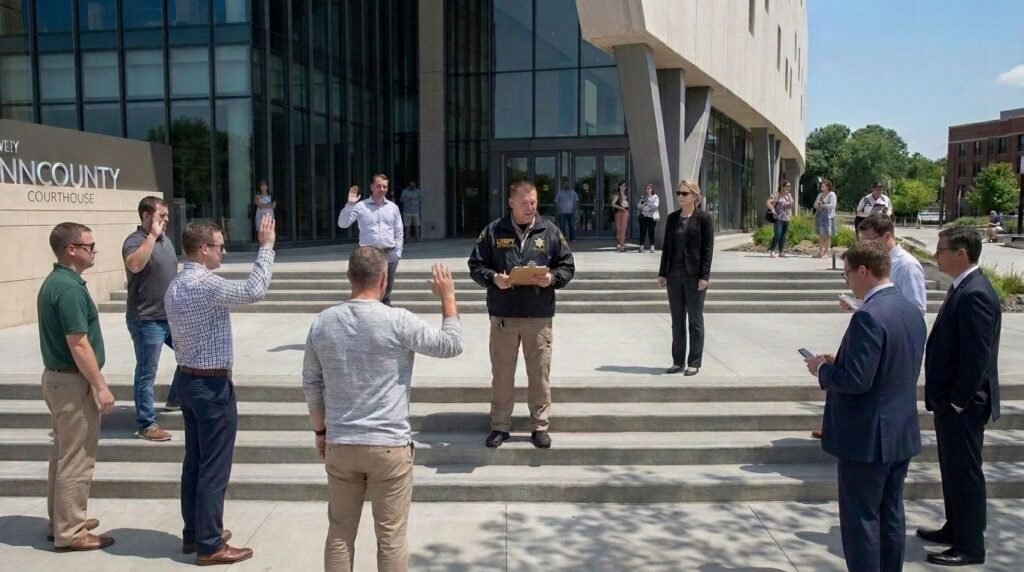
Foreclosures are a very serious reality for many people. If that’s you, there are ways to correct course and get back on your feet. But in context, the number of foreclosures are nowhere near those seen in 2008. In fact, foreclosures as a percentage of all homes is in line or even below historical averages.
So why do we hear so many headlines that sound like we’re about to plunge into another housing collapse? Click bait. That’s it. Sure, you could call me biased since I’m a real estate agent. However, if I show you the actual data, it might give you proper perspective on whether or not YOU want to wait before purchasing a house. Our local market is actually doing quite well. Are foreclosures on the rise in Kansas City? Technically yes, but not really.
National Headlines:
“US Foreclosure Filings Surge 26% in Q1 2026 to 119K” — Laika Labs / sourced from WSJ
“Foreclosures Surge 20% In 12th Straight Month Of Annual Increases” — AOL/Daily Voice
“US Foreclosures Hit 119K Q1 2026, 6-Year High as Bank Repossessions Surge 45%” — BlockNow
“Foreclosure Activity Rises Annually for the Eleventh Straight Month, Extending…” — PRNewswire
“Foreclosures Surged in the First Quarter of 2026” — Yahoo Finance
The National Headline Problem
You’ve likely read or heard headlines like those above. While they’re factually correct, they’re also missing the proper context. Foreclosure filings in 2025 were up 14% over 2024 (367,460 total), which sounds like a lot. However, that’s still 87% lower than the 2.9 million peak back in 2010. HousingWire
We’ve seen high percentage increases since 2021, but these have more to do with the way foreclosures were essentially paused during the pandemic. Since there were virtually zero foreclosures, ANY increases were going to seem large at first glance.
2020–2021 Was a Statistical Floor, Not a Baseline
Protections like forbearance and moratoriums kept foreclosures artificially low in 2020 and 2021. Once those protections expired, filings began to rise again, with 2022 seeing a 115% year-over-year increase. MagicDoor, Inc.
Most experts look to 2019 (prior to the start of the pandemic) as more realistic standard for comparison, calling it “the last ‘normal’ year in real estate.” Compared to 2019, 2022’s foreclosure filings were down 34%, and repossessions were down 70%, according to ATTOM. U.S. News & World Report
Data Shows Normalization, Not Another Crisis
ATTOM Data Solutions is a leading a provider of nationwide property data. Their CEO Rob Barber explicitly said: “Foreclosure activity increased in 2025, reflecting a continued normalization of the housing market following several years of historically low levels.” HousingWire
“While levels remain below historical averages, the quarterly growth suggests that some homeowners may be starting to feel the pressure of ongoing economic challenges. However, strong home equity positions in many markets continue to help buffer against a more significant spike in distress.” PR Newswire
“While filings, starts, and repossessions all rose compared to 2024, foreclosure activity remains well below pre-pandemic norms and a fraction of what we saw during the last housing crisis. The data suggests that today’s uptick is being driven more by market recalibration than widespread homeowner distress, with strong equity positions and more disciplined lending continuing to limit risk.” ATTOM Data
Putting the Numbers in Perspective
The 367,460 properties with filings in 2025 represented 0.26% of all U.S. housing units, which is down from 0.36% in 2019. For comparison, foreclosures peaked at 2.23% in 2010. HousingWire
We’re not even back to normal yet, let alone crisis territory. But what about other things potentially brewing in the current economy in 2026?
What About 2026?
April 2026 saw 42,430 properties filings, up 18% from a year ago. Bank owned homes (REOs) increased 42% annually to 5,098. Barber’s again states: “While overall filings declined from the previous month, the year-over-year increases suggest lenders may be working through distressed inventory as higher borrowing costs and affordability challenges impact some homeowners. Even so, foreclosure activity remains significantly below pre-pandemic levels.”
So what does this actually mean for Kansas City buyers?
How Does Kansas City Stack Up?
June 4th, 2026, ATTOM released its Q1 2026 Housing Risk Report identifying the counties most vulnerable to market declines based on foreclosure activity, home affordability, equity, and unemployment. Of the 50 riskiest counties, 12 were in Florida, 9 in California, 5 in Illinois and 5 in New Jersey. Kansas and the Kansas City metro are notably absent from the list. RealtyTrac
According to ATTOM data, there was a total of just 1 Johnson County, KS property with a foreclosure filing in June 2025, with 1 foreclosure start and 5 REO (bank-owned) completions for the month. The county has 199,541 total residential properties. That’s a vanishingly small number relative to the housing stock. ATTOMdata
Kansas did see one of the sharpest state-level increases in foreclosure starts in Q1 2025; up 117% from 2024. That sounds alarming, but given how few foreclosures were happening in Kansas to begin with, a “117% increase” can represent a very small absolute number. The base effect problem is enormous here. NMP
Also worth noting: in April 2026, Kansas City, Missouri recorded year-over-year declines in REO (completed foreclosure) activity. This bucks the national trend. HousingWire
Why Kansas City Is Structurally Insulated
The Kansas City metro continues to showcase a powerful combination of steady economic job expansion and reliable home equity appreciation, described as one of the most resilient real estate landscapes in the Midwest. Emetropolitan
Today’s homeowners are sitting on an estimated $35 trillion in equity. If they can’t make the payments, at least they can sell their houses and have something to show for it. This is a substantial financial buffer against widespread foreclosures, and is a stark contrast to the 2008 crash. In 2008, buyers were allowed to borrow more than their homes were worth (without proving enough income to afford it). Johnson County, with a median home price of $475,000 and years of pandemic-era appreciation, is particularly well-insulated. REsimpli
In Conclusion
It’s understandable to feel cautious when headlines sound this alarming. Buying real estate will always involve some level of risk (just like driving a car). Luckily, the Kansas City real estate market still remains one of the most stable in the country. Buy smart when the time is right for you, because waiting for another 2008 will likely cost you more.
Questions? Let’s talk!
Justin Rollheiser – Real Estate Agent
REALTOR®
Keller Williams Realty Diamond Partners, Inc.
13671 S Mur-Len St, Olathe, KS 66062
Cell 913-800-7653
Office 913-322-7500
www.JustinRollheiser.com
Comments or Questions?